
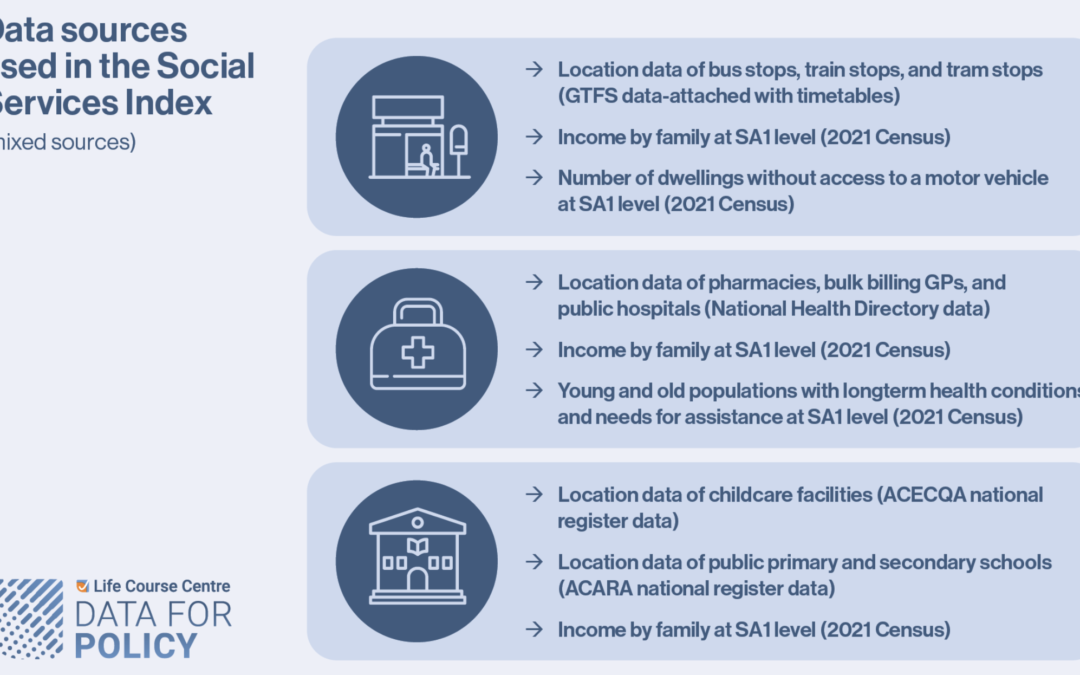
Data sources used in the Social Services Index.
Last week Dr. Mark Stevenson, with the Australian Institute of Health and Welfare (AIHW) publicly announced a new study, “Urban Density and Equity of Access to Social Services.” The study focuses on the unequal distribution of access to services in urban environments. Key findings found that the majority of Australian cities’ Social Service Indices (SSI) rate well below 2/4 for access to services……🤷♂️. It gets worse the further out of the Central Business Districts you go……🤦♂️
What this tells us at UA is that access to services informs our transport choices, significantly. Our urban environments and the ability to travel to and from critical services, within an accessible range, determines what mode of transport we might need to use and whether that choice is sustainable, or not. Increasingly, this has led to higher emissions as Australians need to travel further to access critical services.
Compact cities, as an alternative, can significantly reduce emissions and improve air quality. Imagine if everything was within a 15-minute walking distance? ☀️🍃
The role of mobile telematics, as a single new technology, can positively impact our ecosystems, and our communities, to ensure positive sustainable outcomes for current, and future generations. Great studies like this give us pause to reflect on how we mould ourselves, and our endeavours, into a more sustainable future.
Please click on the following link, which will take you to the Life Course Centre where you can read the full study.